


Diversification is not a strategy. Diversification is discipline. Anyone building a robust and resilient portfolio does not need a forecast for every market movement. They need structure. Diversification reduces risk – without sacrificing potential returns. That is the practical benefit: not hedging at any cost, but rather robustness as a principle of portfolio construction.
The basic idea is simple: By spreading investments across multiple asset classes, you reduce dependence on individual securities, sectors, regions, or market phases. A concentrated portfolio may outperform in good times, but it is significantly more vulnerable to setbacks. A broadly diversified portfolio is more stable, weathered better, and offers a more balanced relationship between opportunities and risks.
Warren Buffett is often quoted as saying that diversification is a hedge against ignorance – that it only makes sense if you don’t know what you’re doing. For us, diversification is not a sign of arbitrariness, but rather an expression of professional and responsible risk management.
Theoretical framework and objectives
Diversification means spreading capital across different investments – so that no single factor determines success or failure. The goal is to reduce what is known as idiosyncratic or unsystematic risk – the risks specifically associated with a particular company, industry, or issuer. These include, for example, management errors, operational problems, product scandals, or regulatory pressures in a single market segment.
The theoretical basis for this is provided by Harry Markowitz’s Modern Portfolio Theory, which is often described as the stock market’s “free lunch.” Its core message is this: What matters is not which individual investments a portfolio contains – but how they relate to one another. It is not the return on a single component that counts – but its interaction with the rest of the portfolio.
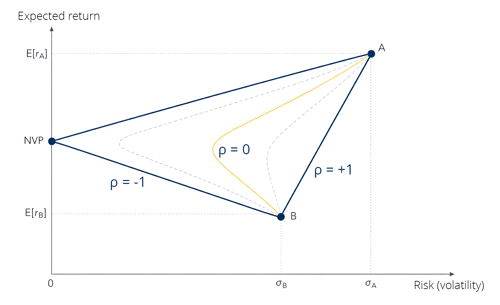
This is where the concept of correlation comes into play. It describes whether two investments tend to move in the same direction, independently, or in opposite directions. If two investments react very similarly to changes in the economy, inflation, or interest rates, their combined diversification effect is limited. Conversely, combining investments that behave differently in various market phases can reduce overall risk, even though the portfolio’s expected return remains attractive. The following chart illustrates this relationship schematically. If you combine two assets with a 100% correlation in equal weights, you end up exactly in the middle between the two – offering no advantage. As the correlation decreases, the risk-return ratio improves. With a correlation of -1, you even achieve the average return of both assets – with zero risk.
A classic example is the combination of stocks and high-quality bonds. In many market phases, these two asset classes react differently to growth and interest rate expectations. If the stock market falls due to economic concerns, government bonds or other high-quality bonds can have a stabilizing effect. This buffering effect is not equally strong in every market phase, but it illustrates the basic principle of professional portfolio construction very clearly.
It is important to distinguish this from systematic risk. General market risks such as global recessions, geopolitical crises, sharp spikes in inflation, or liquidity shortages cannot be completely diversified away. Diversification does not eliminate every risk; rather, it makes a portfolio more resilient to avoidable individual losses.
The various dimensions of diversification
In practical portfolio management, it is not enough to simply hold a large number of positions. What matters most is the breadth of diversification across different asset classes. A professionally constructed multi-asset portfolio therefore takes a multidimensional approach to diversification.
ASSET CLASSES
The most important aspect is diversification across different asset classes. These typically include stocks, bonds, real estate, commodities, and cash. These segments have different drivers of return, react differently to changes in interest rates, inflation, economic trends, and political events, and therefore each serves a different function within the portfolio.
Over the long term, stocks primarily represent capital growth but are associated with higher volatility. Bonds can stabilize returns and take on a more defensive role during certain market phases. Real estate and infrastructure often provide real-term sources of return, while commodities are sometimes viewed as a hedge against inflation or supply risks. Cash, on the other hand, offers low expected returns but provides flexibility and reduces short-term volatility.
GEOGRAPHY AND CURRENCIES
The second key factor is geographic diversification. Many individual investors tend to exhibit what is known as “home bias” – that is, an excessive focus on the domestic market. While this may seem familiar at first glance, it leads to concentration risk when national economic conditions, politics, or industry structure have a disproportionate impact on investment performance.
Broader international diversification across North America, Europe, Asia, and selected emerging markets can reduce this dependence. Added to this is the currency dimension. Different currency regions do not always perform in the same way and can influence a portfolio’s risk profile. Currency risks should therefore not arise by chance but be deliberately incorporated. From the perspective of a multi-asset portfolio manager, this is part of sound diversification.
INDUSTRIES AND SECTORS
Diversification within individual securities – whether stocks or bonds – also means spreading capital across different sectors. Technology, industrials, healthcare, financials, and consumer staples often react differently to growth, interest rates, or changes in profit margins. Anyone who concentrates their portfolio in a single sector faces a high risk of volatility – regardless of how many individual positions it contains.
A mix of cyclical and defensive sectors is particularly important. Cyclical sectors benefit more from economic momentum but often suffer more during downturns. Defensive sectors are frequently more stable during weaker periods. A balanced allocation can help cushion extreme swings.
COMPANY SIZES AND INVESTMENT STYLES
Large, established corporations typically have more robust business models, stronger market positions, and broader financing options. Smaller companies, on the other hand, often offer higher growth potential but are frequently more sensitive to economic cycles and liquidity. For this reason, diversification by company size plays an additional role.
From a fund investor’s perspective, other levels of diversification are important: investment style, decision-making process, and decision-makers. For example, top-down and bottom-up approaches, discretionary and quantitative methods, or individual decision-makers and teams can lead to different outcomes. Diversification across these dimensions can also help make a portfolio less dependent on a single way of thinking.
STRATEGIC IMPLEMENTATION IN DAY-TO-DAY PORTFOLIO MANAGEMENT
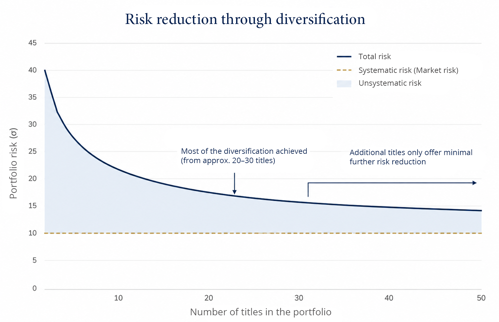
Diversification is not a one-time event, but an ongoing process. In day-to-day portfolio management, the first question that arises is how many positions an investor actually needs. While unsystematic risk decreases as the number of individual securities increases, the additional benefit of each new security diminishes as the number of securities grows. At some point, the risk structure improves only marginally, and complexity and costs outweigh the benefits.
For investors, this means that the goal is not to hold as many positions as possible; rather, it is the right combination that makes the difference. A portfolio with a few, clearly distinct components can be better diversified than a portfolio with many securities that all depend on the same themes. This point is often underestimated, especially during periods of major market trends.
A typical example of hidden concentration risks are portfolios that appear broadly diversified at first glance but are in fact heavily dependent on a single common factor. For example, someone who combines various technology stocks, growth funds, and Nasdaq-heavy ETFs technically holds many positions but remains focused on the same drivers of return. The same applies to investments that are all indirectly influenced by interest rates, the U.S. economy, or oil price trends.
It is not enough to simply count the number of positions. The key advantage lies in whether the underlying risks actually differ. A multi-asset portfolio manager therefore looks beyond just the names of securities; he examines risk factors: growth, inflation, duration, credit risk, liquidity, currency, style, and valuation. Only at this level does it become clear whether a portfolio is truly diversified and, therefore, robust.
REBALANCING AND PITFALLS
Rebalancing is often underestimated. Markets do not perform uniformly. When stocks rise significantly more than bonds or cash over an extended period, their share of the portfolio automatically increases. The portfolio then gradually drifts away from its optimal risk structure.
Rebalancing means regularly monitoring and correcting these shifts. In doing so, investors sell a portion of the positions that have risen sharply and replenish the components that have underperformed. This helps prevent emotional misjudgments and fosters the discipline to act countercyclically. At the same time, it forces investors to continually review their original target allocation and adjust it to changing life circumstances or capital market conditions.
Beware of over-diversification. Too many positions are difficult to monitor, transaction costs rise, and returns are unnecessarily diluted. Diversification without a goal is not a strategy – it is mere window dressing. The chart below impressively demonstrates that, on average, the majority of diversification benefits are achieved with the first 20–30 securities.
Correlations are not static. During normal market conditions, investments may react quite differently, but during periods of stress, they may suddenly fall in tandem. This is precisely why diversification should not be viewed as a rigid concept, but rather as a dynamic process that must be reviewed regularly.
A striking example of this is high-yield bonds, which typically have a correlation of approximately 0.6 with stocks. During periods of economic stress, this correlation can quickly converge toward 1. This also makes economic sense, since in a potential recession, these bonds – which are at the lower end of the capital structure – could default and, if necessary, be converted into equity as part of a subsequent restructuring.
What conclusions can be drawn from this?
For investors, diversification is not a theoretical exercise but a concrete way to protect their assets. It reduces the likelihood that individual poor decisions or specific market events will disproportionately impact the entire portfolio. At the same time, it increases the chance of remaining invested even during weaker market phase – with an eye toward the long-term goal.
When building a robust portfolio, these three practical rules can help:
- Not just holding a large number of securities, but strategically combining different risk drivers
- Not just holding a large number of securities, but strategically combining different risk drivers
- Review the portfolio regularly and rebalance it in the event of significant shifts
Long-term investment success does not come from perfect timing. It comes from a robust portfolio and discipline. Diversification does not hinder returns. It is the prerequisite for capitalizing on opportunities with acceptable risk.
Note: This text was translated using AI and may contain translation errors. The German version of the text is authoritative.